August 5, 2026

Header top telephone number
- Clinic Appts218-927-2157
- Hospital218-927-2121
- Sign in toMyChart
- Online Scheduling
- Apply now!Careers


Header top telephone number
- Clinic Appts218-927-2157
- Hospital218-927-2121
- Sign in toMyChart
- Online Scheduling
- Apply now!Careers
HERNIA CARE IN AITKIN
YOUR HERNIA. YOUR CHOICE. YOUR TIMELINE.
Care built around you.
Explore your repair options, meet with a surgeon by video or in person, and build a treatment plan that fits your life.
95%+
Same-day discharge
2-3 weeks
Contact to surgery
150+
Mesh types evaluated
90%+
Repairs done robotically
BOOK YOUR HERNIA CONSULTATION ONLINE RIGHT NOW – IT TAKES ABOUT TWO MINUTES.
The one thing most hernia patients are never offered: choice
For decades we have worked with patients through a genuine shared decision-making process. Not a recommendation handed down — a plan built together, from repair technique to mesh selection to timing.
-
Every Option Honestly Presented
Robotic, laparoscopic, and open repair. Synthetic, absorbable, biologic, hybrid, or no mesh at all. We are proficient in all of them — which means our recommendation is based on you, not on what we happen to offer.
-
The Decisions Are Actually Yours
Which technique. Which mesh — or none. When to operate, or whether to wait. These aren't decisions we announce; they're decisions we explain, with real numbers, and then make together.
-
Telehealth to Surgery
Many patients complete their entire pre-surgical consultation by video. Rural distance shouldn't delay your care.
-
Watchful Waiting
Some hernias are safe to watch, and we'll tell you when yours is. You'll leave with a monitoring plan, not a sales pitch.
repair & reinforcement options
-
Robotic-Assisted (da Vinci)
Nearly all our repairs -
Laparoscopic & Open
When anatomy calls for it -
Synthetic · Absorbable · Biologic · Hybrid Mesh
All four mesh categories available -
No-Mesh Repair
Discussed openly, offered when appropriate -
Revision · Infected Mesh · Component Separation
Complex referrals welcome
A PLAN SHAPED AROUND YOU
LET'S TALK ABOUT YOUR OPTIONS.
Your questions deserve time and attention. We’ll talk through repair techniques, reinforcement choices and timing, so you can take the next step with confidence.
Video visits available
Start the conversation from home. Your surgeon will let you know if an in-person exam is needed.
UNDERSTANDING YOUR HERNIA
DIFFERENT HERNIAS. PERSONALIZED CARE.
From a first-time hernia to a complex repair, we’ll help you understand what’s happening and explore your options.
The most common hernia – a bulge in the groin. Robotic repair with same-day discharge for nearly all patients.
✔ Inguinal hernias
✔ Umbilical & ventral hernias
Hernias at or near the belly button, from small defects to more complex ventral wall problems.
✔Incisional hernias
Hernias that develop through prior surgical scars – including component separation for large defects.
✔ Recurrent & revision care
Failed prior repairs, mesh complications, and infected mesh – referred from across the region.
Hiatal hernia or not sure?
We also evaluate hiatal hernias (stomach herniation through the diaphragm) alongside our Reflux & Heartburn program.
Not sure? A bulge, pain, or pressure is reason enough. Book a telehealth visit and we’ll figure it out together.
WHEN TO SEEK CARE
IS YOUR HERNIA URGENT?
Know which symptoms need immediate attention and when to contact our team.
Seek emergency care now for:
• A bulge that won’t push back in
• Severe sudden pain
• Nausea or vomiting
• Redness or discoloration over the bulge
• Fever
Go to the nearest emergency room or call 911. Do not wait for a scheduled appointment.
SURGICAL TECHNIQUES
NEARLY ALL OF OUR REPAIRS ARE ROBOTIC. HERE'S WHY.
Robotic-Assisted
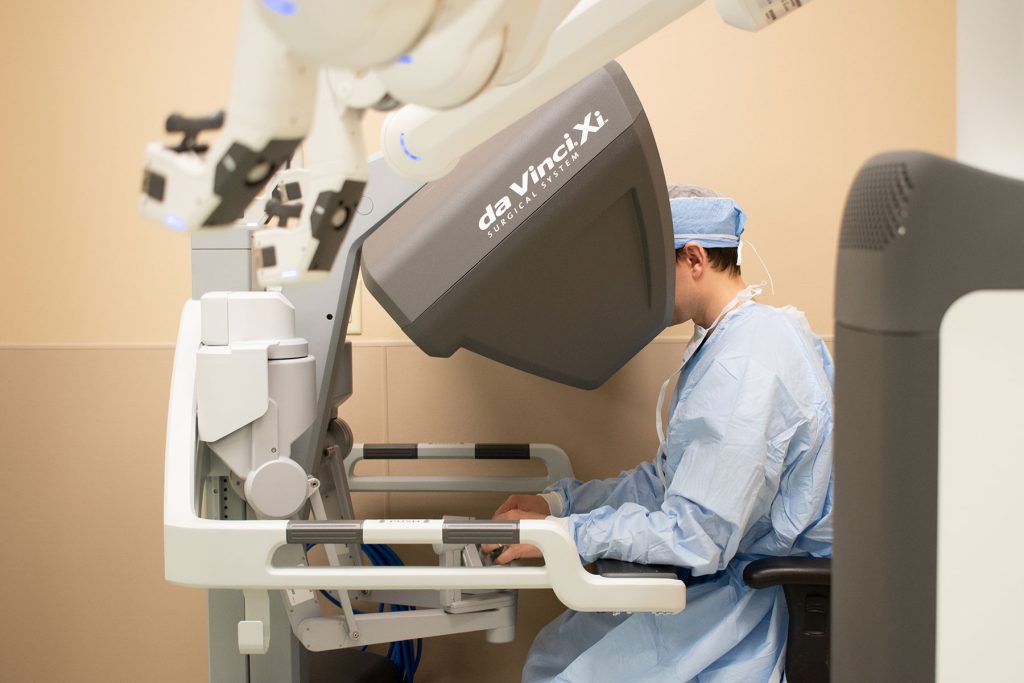
Over the last several years we have transitioned to performing almost all hernia repairs on the da Vinci robotic platform — magnified 3D vision and articulated instruments mean more repairs done minimally invasively than ever before.- A few small incisions, ~1 cm each
- Surgeon in full control — the robot cannot act on its own
- Same-day discharge for most patients
- Less pain, faster return to work vs. open
-
Typical Recovery
Desk work 2–3 days · light labor 7–10 days · heavy labor 3–6 weeks (often sooner with restrictions)
Laproscopic
Traditional minimally invasive surgery with rigid instruments — still an excellent option for selected repairs, with the same small-incision benefits.- Multiple small incisions
- Camera-guided repair
- Same-day discharge common
-
Typical Recovery
Similar to robotic — most patients back to normal activity within a week
Open Repair
A single incision over the hernia — still the right answer for very large or complicated hernias, revision repairs, and patients who can't tolerate general anesthesia.- Component separation available
- Local/regional anesthesia options
- Honest expectations set at consult
-
Typical Recovery
Longer than minimally invasive — timeline individualized to your repair
MESH & REINFORCEMENT
CHOICES YOU CAN UNDERSTAND.
Synthetic, absorbable, biologic, hybrid – or none at all. Four categories, honestly compared, with a structured guide to help you sort out what matters to you.
Synthetic (Evidence-Based Standard)
The workhorse of modern hernia repair, used in the vast majority of repairs worldwide. Excellent track record, lowest recurrence rates. The controversy you’ve read about largely involved recalled older products.
Absorbable Synthetic (Temporary Scaffold)
Synthetic material that your body gradually breaks down – reinforcement during the critical healing window without a permanent implant. A middle path many patients haven’t heard of.
Biologic & Hybrid (Remodels Into You)
Derived from biologic tissue (or combined with synthetic in hybrids), slowly remodeled into your own tissue. Often the answer for patients whose real concern is a permanent foreign body.
No Mesh (Fully Informed Choice)
Safe, feasible, and effective in select situations, with an honest conversation first about the higher recurrence risk for most hernia types. Your call, made with real numbers.
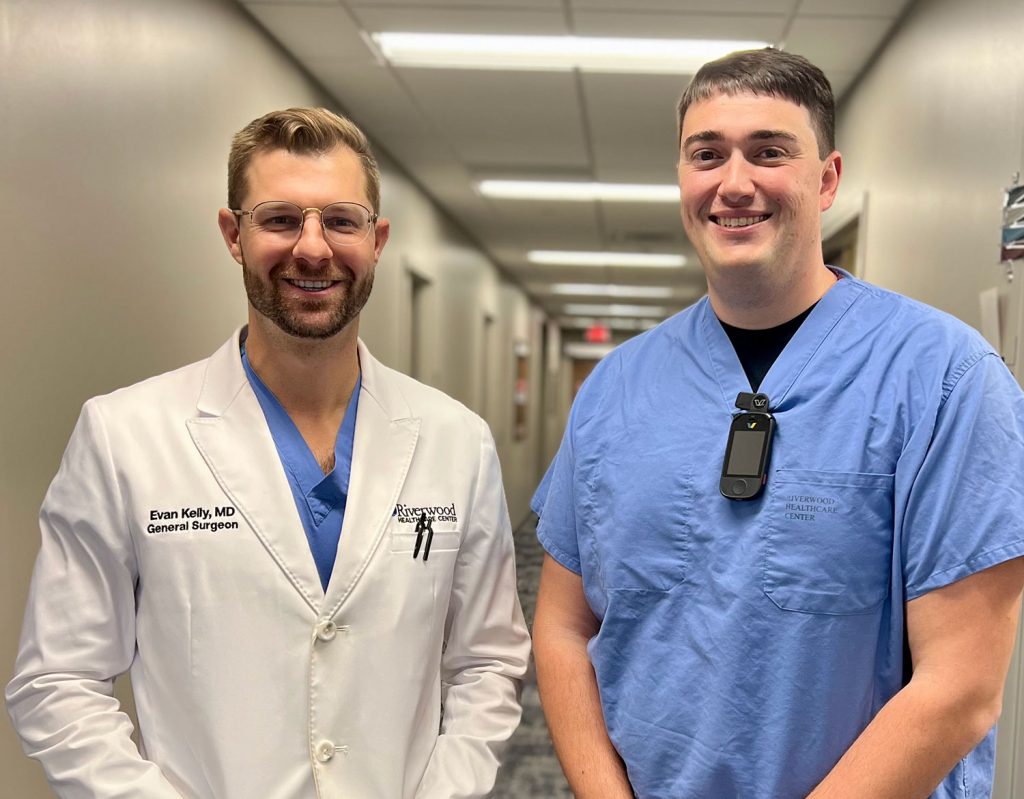
TELEHEALTH CONSULTATIONS
EXPERT CARE.CLOSE TO HOME.
Meet with a hernia specialist from your living room. Choose a video visit when you schedule, then discuss your symptoms, history and care options.
Your surgeon will explain whether an in-person exam is needed before surgery.
WHAT TO EXPECT
YOUR JOURNEY, STEP BY STEP.
Most patients go from first contact to completed surgery in 2-3 weeks, often with only one trip to Riverwood Healthcare Center in Aitkin.
1
Book Online
Schedule through MyChart in about two minutes — video or in-person, your choice. Or call 218-927-6904.
2
Explore Your Options
Browse our educational library before your visit – hernia types, repair techniques, mesh choices – so you arrive with questions, not just worries.
3
Consultation
Meet your surgeon, by video or in person. Every option explained: technique, mesh, timing or watchful waiting.
4
Surgery Day
Arrive, surgery, home – usually the same day. You’ll have your post-op instructions before you ever arrive.
5
Recovery
Most patients return to normal activities within a week after minimally invasive repair. Follow-up can be virtual too.
PREPARING FOR SURGERY & RECOVERY
KNOW WHAT COMES NEXT.
Review your instructions before surgery. Your team will talk through recovery, activity and when to return to work.
QUESTIONS & ANSWERS
MORE ANSWERS.MORE CONFIDENCE.
Your care team is here to help you understand your options and prepare for your visit.
Can I really have my consultation by video?
Yes, and most patients do. Most hernias are diagnosed by history and a focused exam, and the signs are often classic enough to confirm by telehealth. When the diagnosis is clear, surgery can be scheduled directly from the video visit. If we need to examine you in person first, we’ll tell you honestly and combine it with your pre-op appointment so you still only make one trip.
Does a hernia always need surgery?
No. Some hernias are safe to watch, and we’ll tell you when yours is. But a hernia does not get better over time or go away on its own – no exercise of therapy regimen can fix it. Surgery is the only true repair. The question is whether and when it’s right for you, and that’s exactly what the consultation answers.
Is mesh safe? What are my options?
Mesh has revolutionized hernia repair – it dramicallly reduces the chance of recurrence, and well over 90% of repairs worldwide use it. Complications are possible but rare, and many problem products have been recalled. We offer synthetic, absorbable synthetic, biologic, and hybrid mesh, plus no-mesh repair in select situations.
Interestingly, after a thorough discussion, many patients discover their real concern isn’t mesh – it’s a permanent foreign body – and a biologic option that remodels into their own tissue gives them the best of both worlds.
What decisions will I get to make?
More than you expect. Whether to operate at all (watchful waiting is a real option for some hernias). Whih technique – rootic, laparoscopic, or open. Which reinforcement – synthetic, absorbable, biologic, hybrid mesh, or none. Whether your consultation happens by video or in persona, and how surgery timing fits your work and life. Your surgeon brings the evidence and a recommendation; you bring your priorities. The plan comes out of that conversation, not before it.
How soon can I get back to work?
After minimally invasive repair: desk jobs typically 2-3 days, light physical labor 7-10 days, heavy labor up to 3-6 weeks – though most return sooner with some restrictions. Showering, driving, stairs, lifting, and normal activities generally resume within a week. Your surgeon will give you specifics for your job.
Should I limit activity while I wait?
Generally no – we don’t typically recommend restricting activity because of a hernia. The practical rule: if it hurts, don’t do it. Abdominal binders and hernia truss belts from a medical supply store can be temporary comfort measures, but the real fix is repair.
Do I need a referral?
It depends on your insurance plan, but don’t let that stop you – book online or call us and our team will coordinate any required referral with your primary care provider. Self-pay patients need no referral at all.
MEET THE TEAM
REAL PEOPLE. PERSONAL CARE.
Get to know the people behind your care. Learn more about our providers before your visit. Click the provider listed to view their profile.


KEEP THE CONVERSATION GOING
MORE ANSWERS. MORE SUPPORT.
Hernia Blog

One of the Best Healthcare Decisions He’s Made

Hernia patient from Rome, Italy comes to Riverwood for care
December 21, 2023

General surgeon brings advanced training in endoscopic surgery
September 21, 2023

Robotic hernia repair supports rapid recovery
August 9, 2022
Hernia surgery care exceeds patient’s expectations
March 16, 2022

Robotic-assisted hernia surgery speeds recovery
March 3, 2020

